Senior Product Designer

CVENT / COMPETITIVE SET MANAGER

Turning a service-heavy compliance workflow into self-service

Turning a service-heavy compliance workflow into self-service

I led end-to-end design and research for a tool that lets hotel sales teams create and manage competitive sets directly, with real-time validation and guidance built into the workflow.

ROLE

ROLE

Senior Product Designer · sole designer

OWNERSHIP

OWNERSHIP

End-to-end research + product design

TIMELINE

TIMELINE

Q4 2025 - Q3 2026

THE PROBLEM

Hotel sales teams depend on internal teams to create competitive sets, interpret compliance rules, and resolve issues.

THE DESIGN CHALLENGE

Translate complex, changing rules into real-time validation and clear next steps, so customers can build valid sets, correct issues, and understand when edits were allowed.

THE OUTCOMES

Customers can now create, validate, and manage sets directly in the product. Early customer feedback is positive, and internal teams report less routine work. The reduction has not yet been quantified.

THE PROBLEM

A service workflow, not just a list of hotels.

A service workflow, not just a list of hotels.

The visible workflow looked simple: choose hotels, validate, save. Underneath were conditional compliance rules, edit restrictions, hidden Cvent-added venues, and a service process where people interpreted failures for customers. Before I could simplify the experience, we had to align on what the rules actually meant.

BEFORE / A TIME-CONSUMING SERVICE LOOP

BEFORE / A TIME-CONSUMING SERVICE LOOP

Customer

Customer

Provides competitors

Provides competitors

Account Manager

Account Manager

Coordinates the request

Coordinates the request

App Support

App Support

Checks and uploads

Checks and uploads

Saved set

Saved set

Available to use

Available to use

Reporting Team

Reporting Team

Supplies alternative venues to choose from

Supplies alternative venues to choose from

If invalid

If invalid

Explain the issue, opens reporting tickets

Explain the issue, opens reporting tickets

AFTER / CUSTOMER + PRODUCT

AFTER / CUSTOMER + PRODUCT

Choose competitors

Choose competitors

Start with the hotels you want

Start with the hotels you want

Understand and resolve issues

Understand and resolve issues

See what is wrong and fix it in place

See what is wrong and fix it in place

Save a valid set

Save a valid set

Finish with a set that is ready to use

Finish with a set that is ready to use

WHAT THE SYSTEM HAD TO EVALUATE

WHAT THE SYSTEM HAD TO EVALUATE

WHAT THE SYSTEM HAD TO EVALUATE

Eligibility + set uniqueness + property relationships + capacity thresholds + conditional compliance — recalculated as the set changed.

Eligibility + set uniqueness + property relationships + capacity thresholds + conditional compliance — recalculated as the set changed.

WHAT THE USER NEEDED TO KNOW

WHAT THE USER NEEDED TO KNOW

WHAT THE USER NEEDED TO KNOW

01 Can I add/edit this now?

02 What’s wrong?

03 What do I do next?

01 Can I add/edit this now?

02 What’s wrong?

03 What do I do next?

01 Can I add/edit this now?

02 What’s wrong?

03 What do I do next?

CENTRAL IDEA

I didn’t simplify the rules. I simplified the user’s relationship to the rules.

I didn’t simplify the rules. I simplified the user’s relationship to the rules.

01 / THE FOUNDATION

Explain failure, not merely report it.

Explain failure, not merely report it.

A technical error message was not enough for self-service. I paired a persistent validation rail with venue-level guidance so users could see what failed, why a rule applied and what to change while building, rather than after choosing the entire set.

01 / Real time status kept in view

The right rail keeps set-level requirements in view and provides instant feedback.

The right rail keeps set-level requirements in view and provides instant feedback.

02 / Give a way forward

Venue-level copy identifies the failure and describes a corrective action.

Venue-level copy identifies the failure and describes a corrective action.

03 / Explain applicability

The inactive rule explains why it does not apply to the current selection.

The inactive rule explains why it does not apply to the current selection.

DEPRECATED INTERNAL TOOL

DEPRECATED INTERNAL TOOL

The tool surfaced technical failure states, but a person still had to interpret the problem and explain the remedy.

The tool surfaced technical failure states, but a person still had to interpret the problem and explain the remedy.

EARLY EXPLORATION

EARLY EXPLORATION

An early concept treated validation as a separate step. Research showed that it created backtracking, so I moved feedback into the create flow.

An early concept treated validation as a separate step. Research showed that it created backtracking, so I moved feedback into the create flow.

02 / DESIGNING THE LIFECYCLE

Make constraints clear before they become blockers.

Make constraints clear before they become blockers.

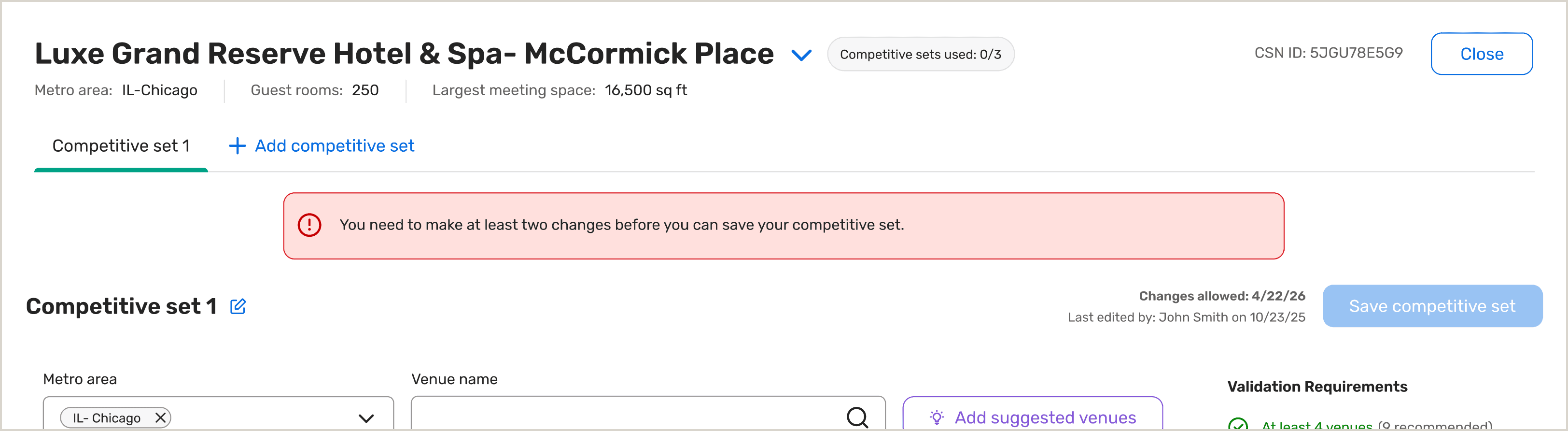
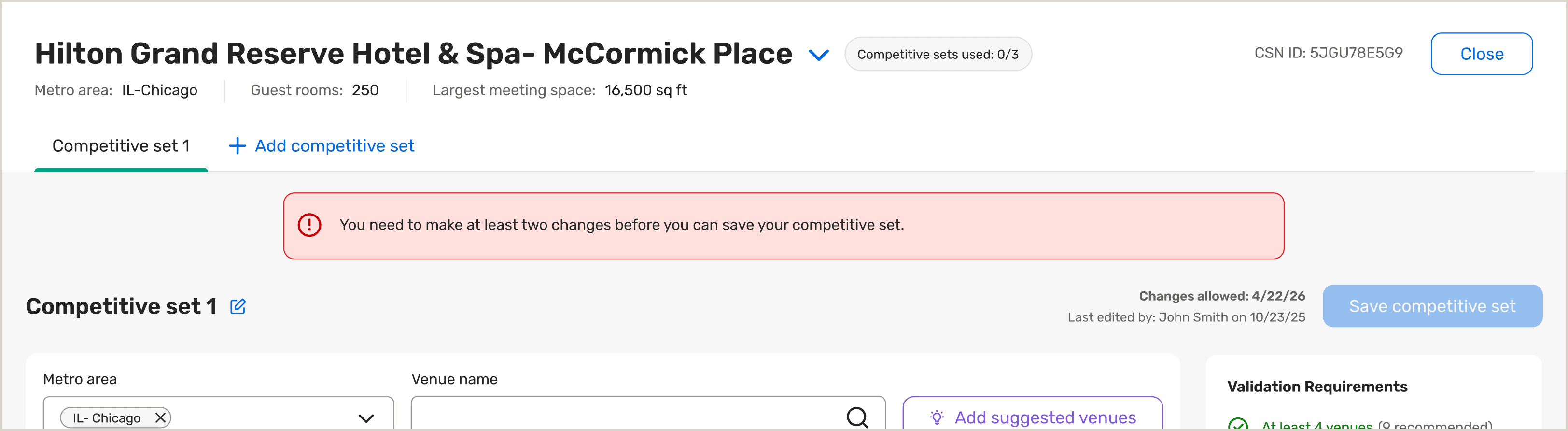
A valid set wasn’t always editable. I treated saving, lockout, and editing as one lifecycle-surfacing each constraint when it became relevant.

INTERNAL STUDY / Q4 2025

Clarity around consequences, timing, and ownership came up repeatedly.

"What happens below 9 venues, the six-month lock, and who last changed the set?"

BEFORE SAVING

What am I committing to?

Explain the six-month lock and exact unlock date before save.

DURING LOCKOUT

When can I edit?

Keep the set visible, show when editing reopens, and show who last changed it.

AFTER LOCKOUT

Have I changed enough to save?

Keep normal validation active; surface the two-change requirement only when it blocks save.

BEFORE SAVING

What am I committing to?

Explain the six-month lock and exact unlock date before save.

DURING LOCKOUT

When can I edit?

Keep the set visible, show when editing reopens, and show who last changed it.

AFTER LOCKOUT

Have I changed enough to save?

Keep normal validation active; surface the two-change requirement only when it blocks save.

Slide 1 of 3

03 / CHALLENGING THE CONCEPT

A valid suggested set was not necessarily useful.

A valid suggested set was not necessarily useful.

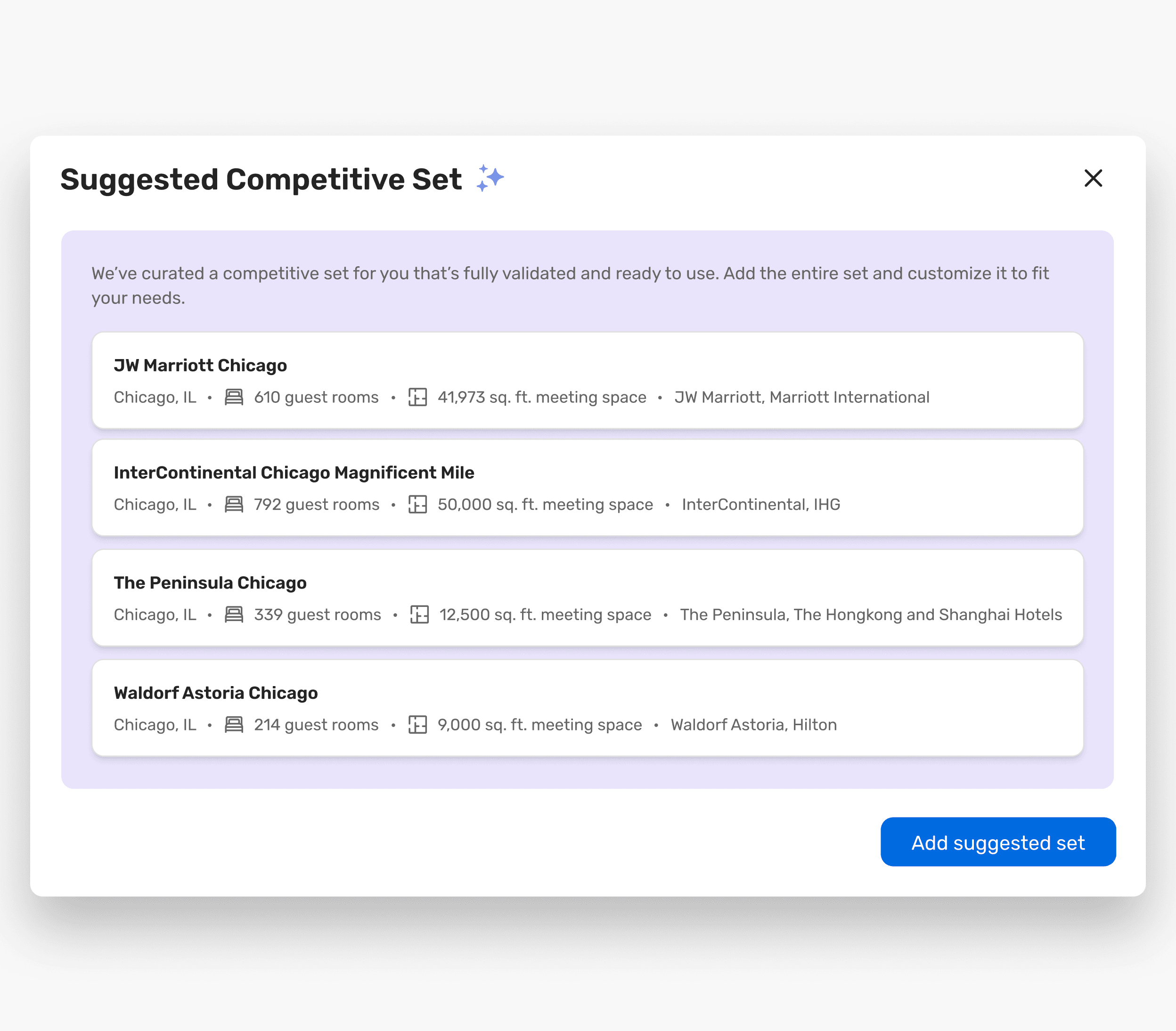
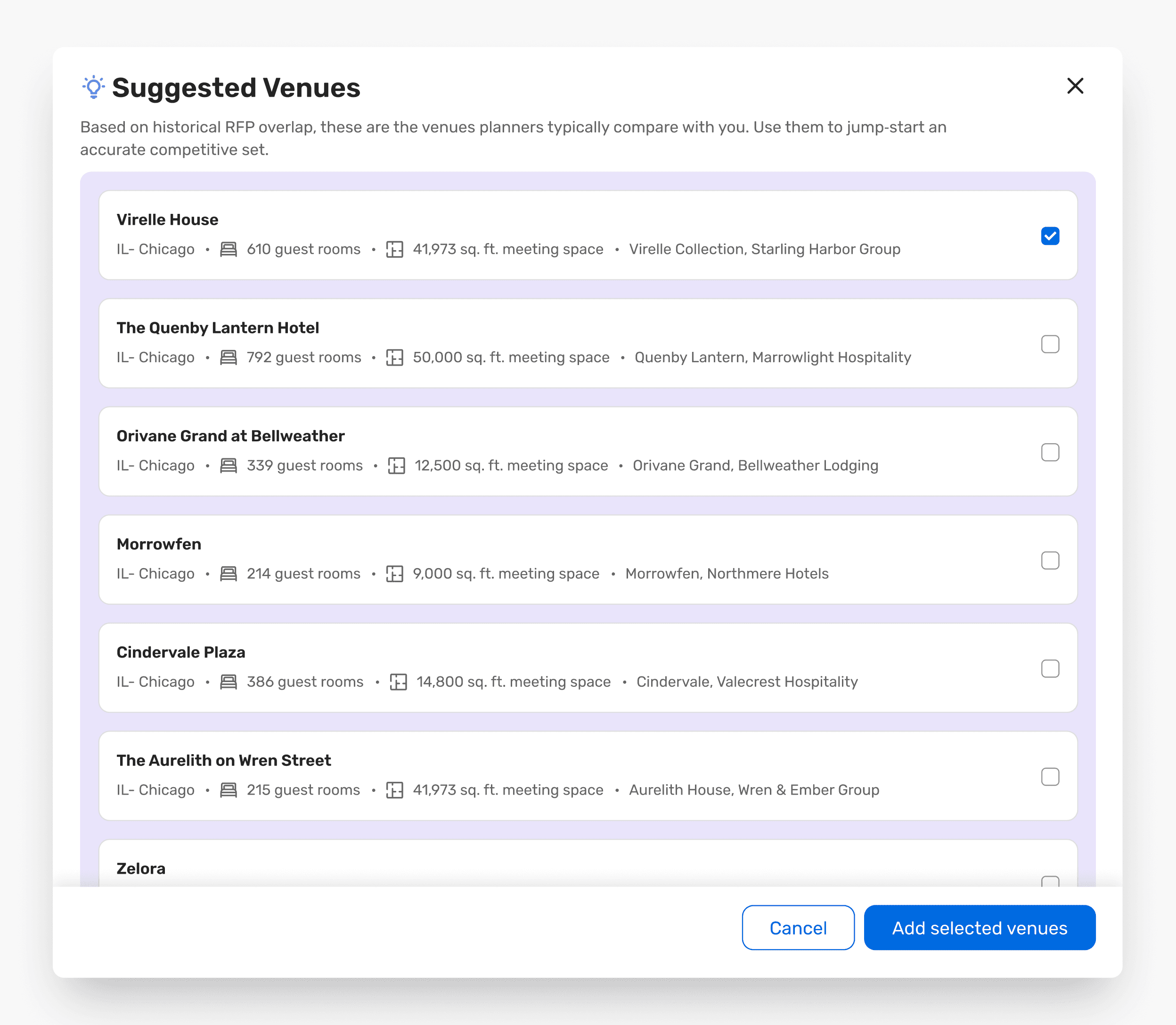
We initially explored a prebuilt Suggested Set. Internal research challenged the premise quickly: most clients already knew who their competitors were. What they wanted was optional help filling gaps — not a system choosing the whole set for them.

INTERNAL STUDY / Q4 2025

All 12 internal participants said clients typically knew who they wanted in their set.

"Suggestions could be useful for newer DOSMs or when someone needs another venue to add, but not complete sets."

EXPLORED / A prebuilt Suggested Set

The early concept promised a fully validated set, whether or not its competitors were useful to that hotel.

REVISED / Suggested Venues, chosen individually

Optional suggestions help users get started or fill a gap. The resulting combination still goes through validation.

EXPLORED / A prebuilt Suggested Set

EXPLORED / A prebuilt Suggested Set

The early concept promised a fully validated set, whether or not its competitors were useful to that hotel.

The early concept promised a fully validated set, whether or not its competitors were useful to that hotel.

REVISED / Suggested Venues, chosen individually

REVISED / Suggested Venues, chosen individually

Optional suggestions help users get started or fill a gap. The resulting combination still goes through validation.

Optional suggestions help users get started or fill a gap. The resulting combination still goes through validation.

Slide 1 of 2

PRODUCT JUDGMENT

Recommendation ≠ validation.

Recommendation ≠ validation.

Suggestions help users get unstuck without choosing their competitors for them—and the resulting set still has to pass validation.

WHAT CHANGED

Eliminated the need for a separate internal support tool.

Competitive-set validation and guidance now happen directly in the customer product.

Improved customer satisfaction.

Improved customer satisfaction.

Early customer feedback indicated satisfaction with the new tool.

Early customer feedback indicated satisfaction with the new tool.

“Great upgrade that’s easy to manage. I know quickly if it’s valid or not. I just wish I could bulk upload sets for multiple properties.”

-Early customer feedback

“It’s super easy to use and I’m glad I don’t have to wait to talk to someone to get it done!”

-Early customer feedback

Slide 1 of 2

“It’s super easy to use and I’m glad I don’t have to wait to talk to someone to get it done!”

-Early customer feedback

“Great upgrade that’s easy to manage. I know quickly if it’s valid or not. I just wish I could bulk upload sets for multiple properties.”

-Early customer feedback

NEXT OPPORTUNITY

NEXT OPPORTUNITY

Multi-property bulk upload and creation workflows

REFLECTION

User simplicity did not mean simple to design or build.

User simplicity did not mean simple to design or build.

Self-service required the product to absorb the exceptions and recovery steps people had previously handled manually. I recognized early that the scope was being underestimated, but I wasn’t always effective at making that complexity visible to the team. Next time, I’d surface the rules, dependencies, and downstream effects before timelines and expectations hardened.

SELF-SERVICE PRINCIPLE

Good self-service design is less about removing people from a workflow and more about making sure the product can take on the judgment they used to provide.

Good self-service design is less about removing people from a workflow and more about making sure the product can take on the judgment they used to provide.